
This spring I got the opportunity to flip the script on my dad and teach him a thing or two about hunting. My dad taught me just about everything I know about deer hunting, but he never really got as into turkey hunting and has never actually harvested a bird. Independently of him I took a shining to turkey hunting and have harvested a handful of birds over the years. This year he decided that he wanted to go with me on my turkey hunting adventure, so for the last weekend of the season I brought him along as a non-hunting observer (he may not know it yet, but next year we’re going to put him on the gun) and frankly I couldn’t have dreamed up a better full-circle, all-emotions encompassing turkey hunting experience than the one he and I had over the course of just two mornings in the woods.
Having gotten my butt handed to me by both uncooperative birds and a nonstop barrage of inclement weather during the first two weekends of the season, my outlook on the final weekend’s hunt was far from optimistic. During the first weekend I spooked birds walking in and walking out on multiple occasions and listened as the neighbor let loose on what I can only assume was the same bird I had interacted with earlier that same morning. A little investigative online sleuthing confirmed that the neighbor did indeed bag a gobbler that morning, and a triple-beard at that. Talk about disheartening! Be all that as it may I chanced to try again the second weekend, driving three hours to the lease for one remarkably unfruitful afternoon before rain and thunderstorms moved in for the remainder of the weekend. In all honesty I was ready to cut my losses for the year and would have been inclined not to even bother trying to dodge the rain and hunt the final weekend at all had it not been for his interest and willingness to tag along.
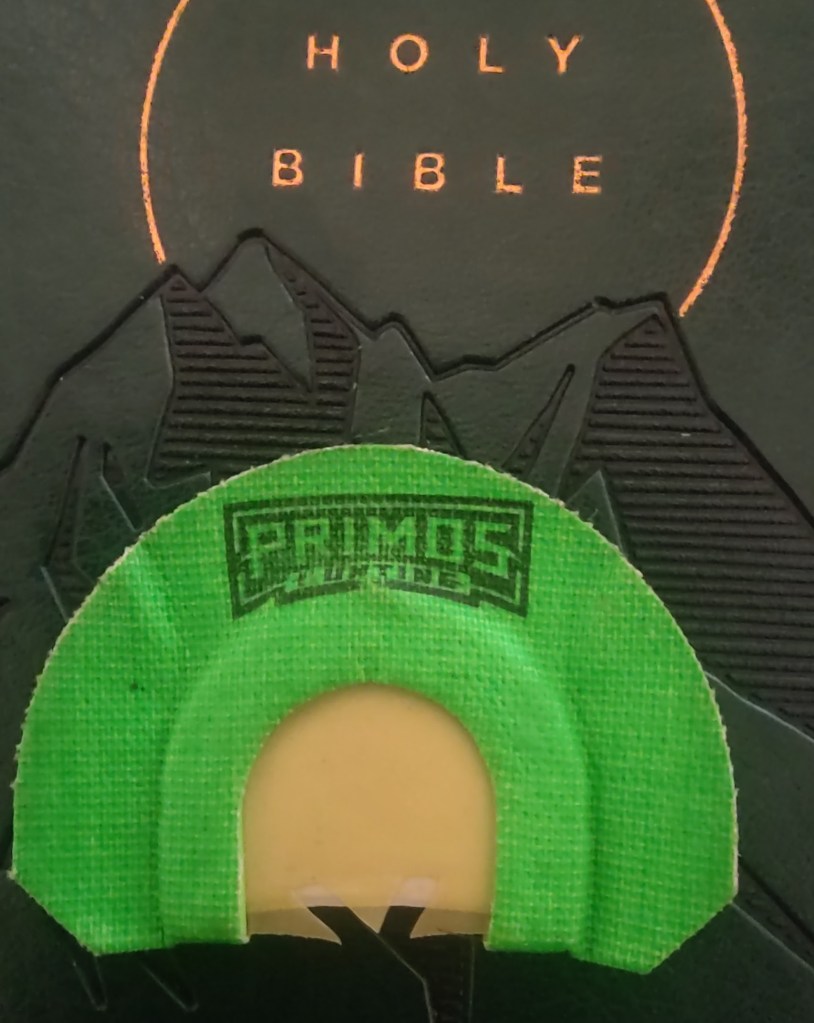
With both of our work schedules affording us Fridays off, we chanced to forego the rare opportunity to sleep in and made our way to the woods, arriving just as the sun was starting to come up. Much to our chagrin we discovered that the farmer had turned his cows loose on the pastures where we hunt, and my immediate concern was that the sudden presence of said cattle would negatively impact the behavior of the birds. We made our way to a small side meadow in hopes that the cows wouldn’t bother us tucked off away from the main pasture, which mostly worked even though a few did end up grazing across the far end of our meadow. Being as it was so late in the season I only set out my hen decoy in the open field and we settled into the wood line. I broke out my Primos – The Karen Hen Series mouth call and officially started the hunt with the first series of clucks and chirps.
Immediately we got a response, a tom maybe a hundred yards south to our left hammered off a gobble in an area that always seems to have a roosted bird. Two years ago at the recommendation of an experienced turkey hunting club member I had hunted over that direction and harvested an early morning bird there, and with that first gobble it appeared that a similar hunt was in store for us on this day. Quickly following his gobble another tom fired off back to our right, much further away to the north and east. As luck would have it, we never heard from the bird to our left again the rest of the day. My second series of calls elicited a follow-up response from the bird to our right, still a few hundred yards off but definitely engaging in conversation with me. Over the next fifteen to twenty minutes I exchanged calls back and forth with him, each time his gobbles getting closer and closer. He was coming in on a rope right to us, and I could hardly believe this was working so well. With where my decoy was positioned, my hope was that he would work his way out into the field and wrap around the corner to our right, setting up for a perfect shot opportunity should he pull up short of the decoy. My only real fear at this point was that he’d work his way through the timber and come in directly behind us, as our cover at our six was not nearly as sufficient as what we had in front of us.
Those fears were eventually confirmed as his last gobble exploded directly behind us, and more out of reflex than anything I turned my head to look over my shoulder. It wasn’t a great deal of movement but it was enough and when I turned I saw his bright blue and red head and neck pop up at 10 yards behind us. The next thing we heard was him putting and popping as he quickly exited the area back the direction he had come in from. Dammit, if I had just sat still… His next gobble was back to being a considerable distance away, and while he was still responding to calls he wasn’t going to come back. I turned to dad and we lamented the disappointment of such a close encounter without getting a shot off. I considered trying to quickly swing my shotgun around when I caught that first glimpse of him, but froze instead, hoping he hadn’t caught my movement but that obviously wasn’t the case. Just a few minutes later, with him still gobbling in the distance, we heard some clucking once again directly behind us. A hen had worked her way in and she got within about fifteen yards before it was dad’s turn to have a slight movement discourage an incoming bird.
Dejected by the results but still excited about the encounter, we decided that trying to pull a bird back to this spot would be an exercise in futility, and we packed up our gear and set out to try a new approach; working our way to the other end of the field to our north to see if we could pull that tom to us from the other side of his hangout. This proved to be another exercise in futility, as by the time we got where we wanted to go he had turned it off and was either done gobbling or had moved out altogether. We got the idea to try a big move further south to see if we could get on that first bird that gobbled once and then went silent. Our journey led us to a small little patch of meadow up on top of the hill at the south end of the property where I had had a couple of chance encounters with birds last year. Along the east edge of the field there was a tree that had broken off and fell out into the field. I staked the hen out just off the end of the branches of that tree and we backed in against the trunk of the tree, which was big enough to not only provide a backrest, but also good cover behind us. Once again I popped the mouth call in and let out a few chirps, just to see what kind of a response I could get, and boy did I ever get a response!
From just inside the timber directly across the field from us, a hen piped up and started clucking aggressively. I would imagine she’s probably the same hen I described in Hunt the Hens from last year, as this was that same spot where I had her behind me and between myself and an incoming gobbler. Ultimately she busted me and it cost me a chance to harvest that bird. I responded to her clucks, she chirped aggressively again, and next thing I see is her blue/gray head bouncing through the grass as she came racing in at a dead sprint, pulling up as she got to my decoy and taking inventory of the situation. Now, I’ve pulled hot gobblers to me before, and I’ve even drawn hens in right to my decoy, but I have never seen a bird of either sex come running in like that! To have that happen on the heels of pulling in the earlier gobbler to within ten yards was all the confidence and confirmation in the world a turkey hunter could ask for in his calling abilities. Or maybe Primos just makes a damn good call. After all, their slogan IS ‘Speak the Language’ and that Karen call certainly had me speaking the language that morning.
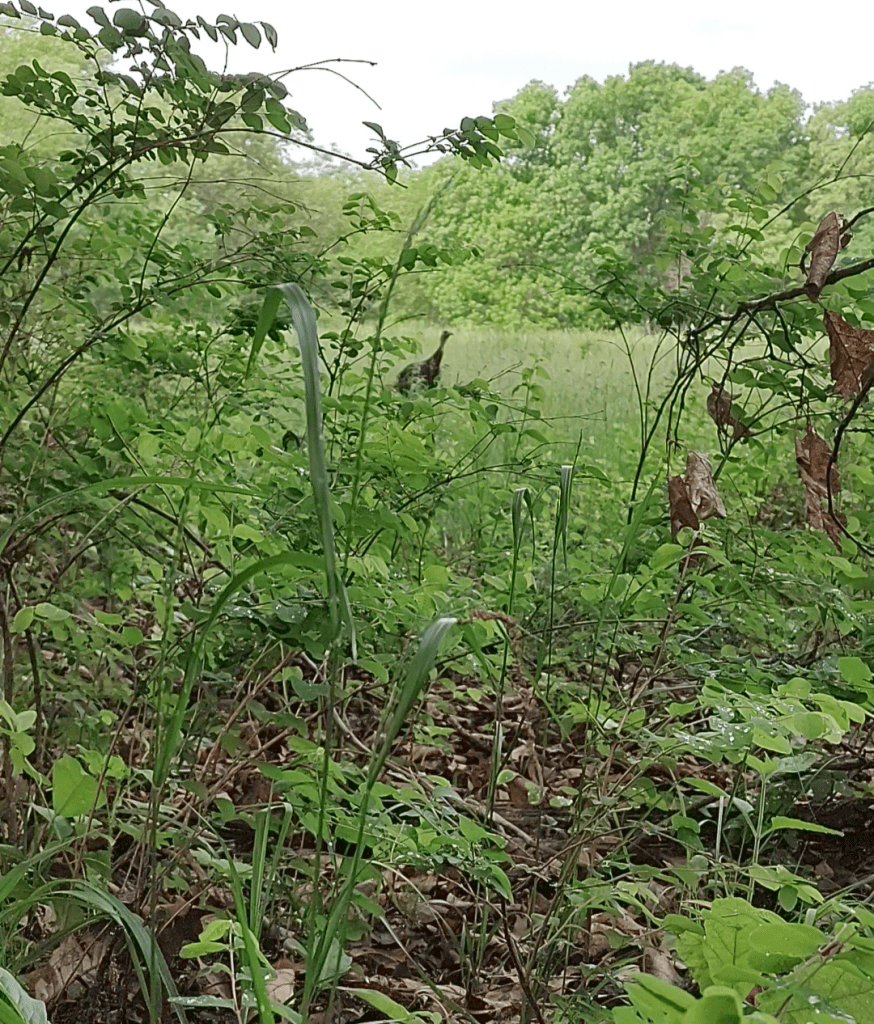
Of course, once she was in front of us inside of twenty yards I didn’t dare make another peep for fear of drawing her attention directly to our hide and risking spooking her. She proceeded to start pecking around and feeding in the grass, wandering all around the decoy, setting us up for the perfect opportunity to put into practice exactly what I had just written about in the previous week’s article, Hunt the Hens in which I describe the advantages of using the presence of a live hen to draw in gobblers. At one point she hopped up on a branch of the very same fallen tree we were backed in against, putting her about six feet off the ground and out of the uncut grass and proceeded to start preening her feathers just ten yards from us. She stood up on that branch for several minutes, picking and preening at her feathers, periodically pausing to assess her surroundings. She dropped back down into the grass and slipped just into the brush on the edge of the field whenever a small prop plane flew low overhead, but quickly reemerged in the grass once it had passed. Over the course of the next hour, she milled around along the field edge in front of us, getting as close as perhaps seven to ten yards and never really further than forty or fifty yards. This sort of trapped dad and I in an uncomfortable situation of not being able to adjust our seating or stretch our legs out for fear that any movement could scare her off, leaving to suffer sore backs and legs that were falling asleep due to a lack of adequate blood flow. All the while we never heard any gobbles or any kind of indication of other birds in the area, and I was beginning to think that she either needed to make her way out or we were going to inevitably run her off. Just as I was starting to lose hope in any toms showing up, I caught movement out of the corner of my eye, just off the end of the deadfall where she had perched and preened herself. Jakes!
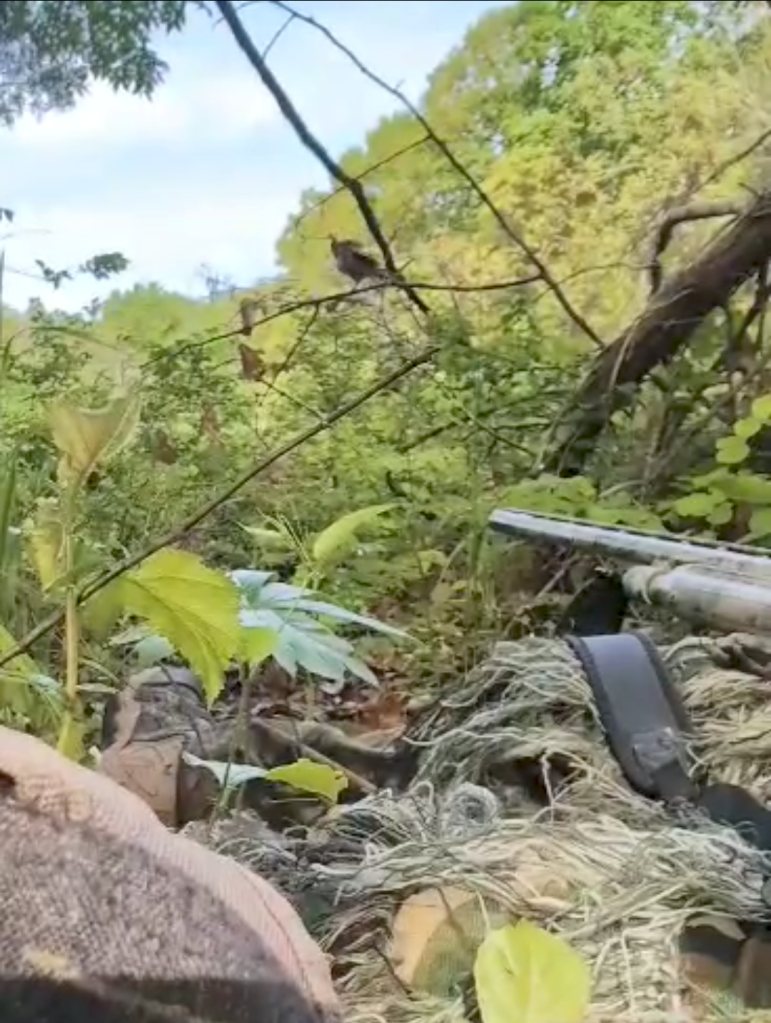
I turned my head to see two young jakes standing there within fifteen yards of us, and more movement behind them as more birds came into view. A group of five in total, they froze right there for some reason and then worked across the field and down the edge of the far tree line while the hen remained out in the open in front of us. As they slowly wandered away from us I chanced a soft chirp or two, hoping I could illicit a gobble or two out of them, if for no other reason to give dad an opportunity to hear what jake gobbles sound like as they tend to differ from the gobbles of a mature tom. While they did perk up at my chirps, they didn’t seem interested in talking and continued to skirt down the far edge before eventually turning and working their way back across the middle of the field out in front of us. At one point dad whispered that I probably don’t want a jake anyway, to which I responded that with it being the final weekend of the season I would gladly settle for a jake. He then asked if I had my full choke in, which I affirmed that I did indeed.
“You could hit one from here then, if you want to shoot.”
I determined that he was right, since they were now approaching the thirty to forty yard range, and my Mossberg 835 could easily reach out and touch one with the 3 ½” shells I had loaded. Now came the hard part; raising my shotgun to my shoulder and getting a bead on one of the jakes separated enough from the others to ensure only hitting one bird without catching one of the now six sets of sharp eyes less than fifty yards from us. Slowly and carefully I shouldered the Mossberg and waited for one to step into place for a shot opportunity. As one jake turned and presented me with that chance, I lined him up on the bead and squeezed down on the trigger. Click!
I should pause here and inform you, the reader, that this Mossberg pump of mine is almost fifteen years old and has been my turkey, squirrel, duck, dove, rabbit, and clay pigeon gun for the duration of its life. I have easily put a couple thousand shells through this gun, and have beat the ever loving crap out of it. It’s been used and abused, rode hard and put away wet. I had to have a gunsmith heat the barrel to break free a choke that had more or less become one with the barrel. In recent years the action has become somewhat unreliable and on occasion while duck hunting I’ve pulled up to shoot and had the gun not fire.
As luck would have it on this morning that is exactly what happened. I could feel with my finger that the pump release on the side of the trigger guard was stuck in, meaning it was not fully locked into place, not allowing the firing pin to strike the shell. That click was enough to catch the attention of the birds in front of us and all of them perked up and looked our direction. Panicked, I knew there was only one way to correct this issue in the moment, and dreaded having to risk spooking off what could well be my only opportunity to harvest a bird for the season. As smoothly as I could I half-racked the pump and jammed it back out, feeling the release pop out like it was supposed to be. I realigned my shot and gave the trigger another squeeze. BOOOOOM!
Thankfully the re-rack worked and my bird dropped into a flopping heap as feathers puffed into the air. The rest of the birds went into a frenzy, jumping up and running around in utter bewilderment, confused about what had just happened. As we jumped to our feet dad proclaimed that the others were still in range, and that I could shoot another if I hurried. This would have been tempting, since I still had two tags I could fill, but Missouri’s regulations state that you may only take one bird during the first week, and then the rest of the season you can only take one bird on a given day. Nonetheless, I would really only want to take one jake anyway, leaving the rest to have the opportunity to grow another year and further bolster the population next year. The others finally ran off as we walked out and collected my bird. We snapped a couple pictures, gathered our gear and made our way out.
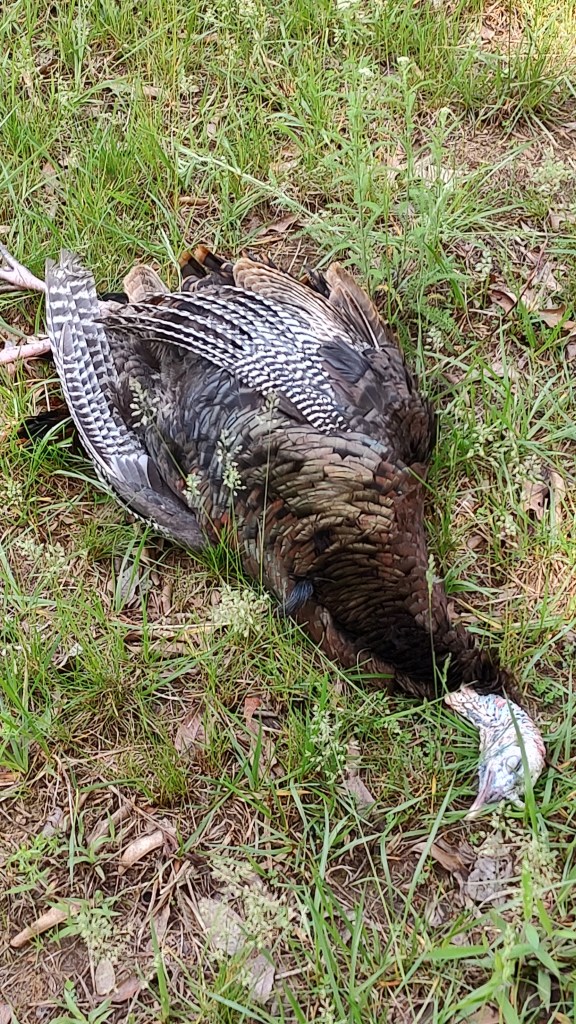
With more impending rain in the forecast for the next day, it looked like we might only get a couple of hours at most to hunt, so we figured we’d give that long beard from the first part of the morning another quick attempt in the morning. This meant spending the night down at the clubhouse, where we could clean my jake and cook some deer burgers (from my deer last fall) and just hang out for the afternoon/evening. We carved out the breast meat and decided to try and harvest the drumsticks, which aren’t generally of much value on wild turkey. Of course I collected the 5 inch beard and the fan, which I can use on my jake strutter decoy in future years. I also cut off the legs with the short nubby spurs, and just for fun I took the head, which I’ll play with doing a European-mount style clean out of the skull.
The following morning we slipped in to the timber north of where we pulled that hot gobbler to us the day prior, in what we believed to be the area in which he was roosted the day before. I staked out the hen decoy and we settled in along the ditch, facing east, keeping one eye on the woods and one on the radar, ready to break down and head out if the rain started to move in. Through the semi-dark of the early morning twilight I caught movement about eighty yards up the hill directly in front of us, and watched what I can only assume were the four remaining jakes from the previous day drop down off of the roost. Holy crap, we accidentally set up right on the roost! I don’t know if we could have pulled that off any better if we had known the birds were roosted there. Not wanting to shoot another jake, I waited them out in hopes of the long beard showing up. Not that it really mattered, because the jakes seemed to be rather uninterested in my calling, never coming down to us and instead working their way around us to the north and back to the west behind us. The gobbler seemed to not be among them as we had hoped, and we were starting to lose hope in the morning’s hunt.
He must have slept in that morning, and when he finally decided to start gobbling, he was south of us, back toward where we had first encountered him yesterday morning, figures. Not nearly as fired up on this day, he only gobbled occasionally, but still seemed to be working our direction before going silent for an extended period of time. When he finally fired back up he was clear over on the other side, north and east of us. He circled his way all the way around us to the north, into the area where the jakes had moved to. Just as the intensity was starting to pick up as we were getting ready for another encounter with him, a renegade raccoon walked right up to and then right past my decoy. If not for raccoon season being closed and the gobbler coming in, I may have been tempted to derail the hunt in exchange for letting my Mossberg eat on the notorious little nest raiding sapsucker, but alas, I let him walk on by and returned my focus to the target at hand.
The gobbler continued to work his way around, once again not following the game plan of coming out in front of us, but instead choosing to get in behind us to the west. I don’t know how close he got this time, because I didn’t dare chance turning to look again, but he was close enough that we could hear every putt and click and drum. My guess, after later evaluating our surroundings behind us, would be that he was about twenty yards away and was probably strutting and drumming in a small open spot in the underbrush, trying to pull my hen decoy up to him. While he was doing that I caught sight of one of the jakes wandering by to the north at about forty yards, and had I been inclined I probably could have taken a shot at him. His path was taking him around our left side and from the sounds of the commotion that shortly followed, he crossed paths with the gobbler and after a few wing flaps and putts and chirps, the woods fell silent once and for all and we never heard another peep the rest of the morning. Despite the rain falling apart before it got to us, we resigned ourselves to calling it quits for the day and for the season and heading for the house.
Despite not being able to close the deal after two close encounters with the long beard and ultimately settling for a jake harvest, it was one of the most unforgettable and action-packed turkey hunting weekends I’ve ever had. Making it especially memorable was having the opportunity to give my dad that experience. I know he enjoyed it every bit as much as I did, and I reveled in the chance to get to share that experience with him, explaining my thought processes on what moves to make and when to call, keying in on the different types of calls that turkeys make and differentiating the calls of hens from those of toms, and even getting to educate him on the one-per-day hunting regulations. To be able to at least partially return the favor to the man that has taught me so much about deer hunting made it a truly special weekend that pretty much checked all the boxes of what a turkey hunt can entail, the ups and downs, close calls, irritating mistakes, and extreme patience necessary to pull off a successful harvest. I won’t soon forget this past weekend, and I know he won’t either. And you can count on two things for next year: 1. He’s getting his turkey tags and he’s going to turkey hunt. 2. We’re going after that bird that escaped us twice in two mornings.
 The Hunting Lodge