Gobblers aren’t gobbling? Or they’re gobbling just a little (primarily on the roost) but they’re clearly locked up with a hen? Either way, they simply aren’t buying what you’re selling. Even the most experienced hunters and expert callers will admit that it is extremely difficult to pull a gobbler away from a hen he’s already got eyes for, if not altogether impossible. So how do you close the deal on him? As strange as it may sound, forget about him for a minute; focus on her. If you can pull a hen in, oftentimes that gobbler will tag along, or he’ll lose track of her and come looking and accidentally find you instead. It’s a risky maneuver, and speaking from experience it can quickly derail a hunt if/when she busts you.
I don’t know if it’s an issue of territory or jealousy (or a combination of both) about another girl talking to her man, but hens can and will get just as fired up as toms when it comes to a strange woman chattering in their domain. Using hens, I have harvested one or two gobblers and had several other close encounters in which I was not quite able to close the deal (a result of the aforementioned risk associated with getting busted by the hen). Nonetheless, hens have proven to be my golden ticket to filling a tag and thus have become a valuable tool in my ever-expanding turkey hunting bag of tricks.
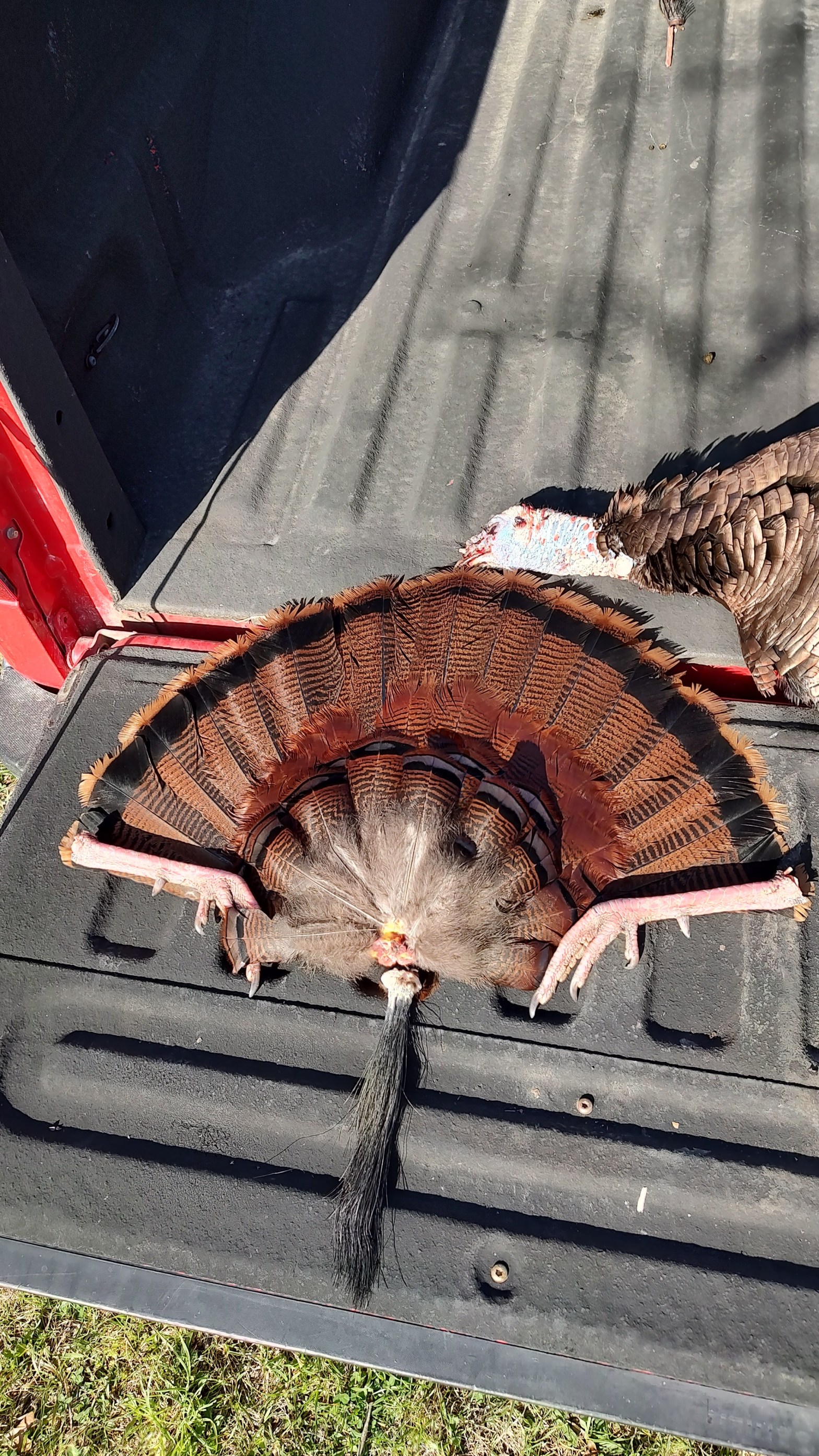
On one such occasion, I was sitting just inside the wood line with my hen decoy staked out in a small corn field, with a draw running down through the timber back to my left and tying into the creek bottom below. With little action that morning in the way of gobbling, I had resorted to only calling occasionally, waiting about fifteen minutes between sequences of clucks and putts and chirps. I noticed at some point that when I turned my head and called down that draw, it echoed mightily, so in my relative boredom I decided to play with that a little. After doing this a couple of times and really getting some good echoes, I got a response. It wasn’t the booming gobble I was hoping for, but rather a hen that was feeling either chatty and neighborly or perturbed at the sound of another hen in her territory. Either way, I struck up a conversation and started into a back and forth with her, more or less mimicking her calls back at her. After a few exchanges I suddenly got the gobble I was waiting for. Then another. Then multiple gobbles simultaneously. I watched down the edge of the field when she seemingly materialized out in the open out of nowhere and immediately took off running across the field. I would hardly think she busted me that quickly and easily, or maybe my beat up old fan I had haphazardly propped up in the grass, but perhaps it was my hen decoy that spooked her. Regardless, she was off to the races and gone almost instantly. But she was leading a small parade, and a moment later a big tom stepped out right where she had just been. Being less anxious, he continued walking at a steady pace toward my decoy, passing behind the brush I was using for cover and heading straight for my open shooting lane. However, he stopped just short of coming into that lane, turned 90 degrees, and marched directly away from me, skirting around my setup at about 80 yards. Defeated, I settled back into my seat just in time to catch movement out of the corner of my eye back over to my left where the first two birds had materialized. I turned to see three more gobblers in full strut, prancing out into the field. Not to chance missing another opportunity, I slowly and carefully turned my shotgun toward them, brought it up, and picked out the lead bird of the three and let ‘er rip. As luck would have it, this two year old bird turned out to be rocking a strong double beard of 10 ½ and 6 ½ inches, respectively.
“The hen giveth, and the hen taketh away.”
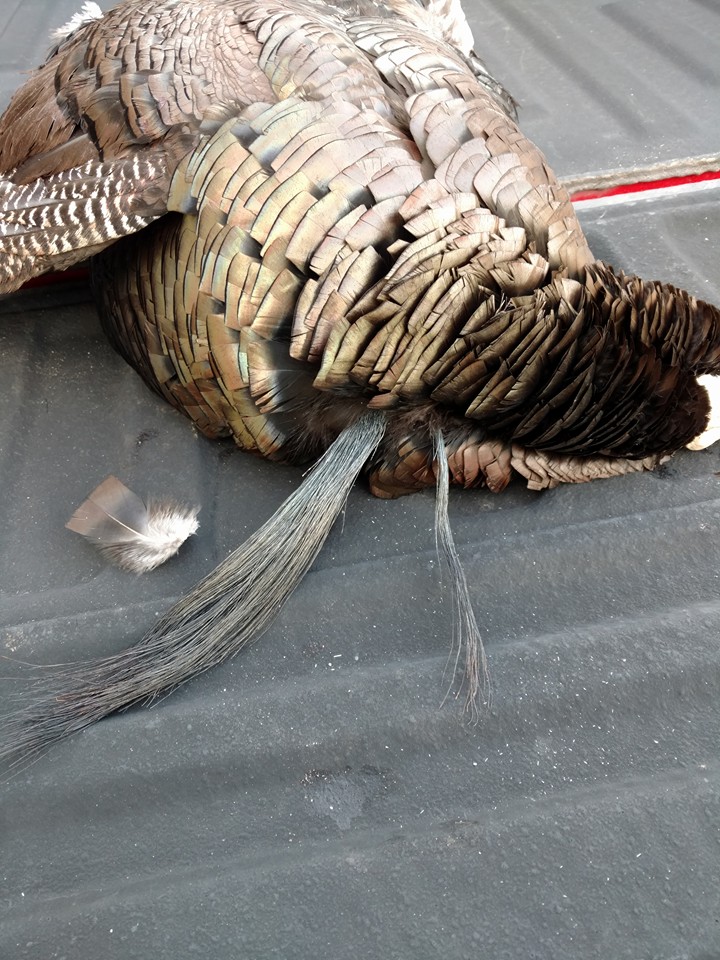
Just last year, after several mornings of little to no gobbling, I finally hit a rather productive early morning hunt, working two or three different gobblers in quick succession in the first hour of daylight. Inevitably each one would eventually trail off, likely going off with some other hen that was more successful at harnessing their attention. As quickly as it all started, my morning became filled with silence as I was left to sit and twiddle my thumbs as the hours passed. At some point during the mid-morning hours I started hearing an infrequent tick-ticking noise somewhere behind me in the timber. I wrote it off as nothing more than a woodpecker or a squirrel or some other critter, and certainly didn’t register it as the sound of a turkey. Every few minutes a tick and then silence. Eventually I heard a distant gobble behind me, probably a few hundred yards away. I perked up at the sound, but wasn’t sure if that’s what it was, so I awaited confirmation. A moment later I got my confirmation with another gobble, which prompted me to throw my call in my mouth and go to work. As soon as I let out a string of chirps and clucks to get his attention, that tick I had been hearing ramped up into an extremely agitated sequence of putts and clucks. As it turns out, that noise I had been hearing for the past hour was a hen the whole time, and at this point she wasn’t far behind me! I hastily pulled my mask over my face and called again. What transpired in the following minutes can only be described as a frenzy of calling, with the gobbler firing off at her every bark and chirp, me clucking in response to his gobbles, and her snapping at my calling. Nervous about upsetting her, I continued to respond to the gobbler because he was coming in on a string and getting closer with each gobble. My head was strained as far as it would turn to the left, trying to see the action unfolding behind me, when she finally came into view in my periphery not but twenty yards away. As she strolled through the sparse underbrush she hopped up on a fallen log and disappeared as she dropped down on the back side of it. Seizing my opportunity to get turned around with her sight of me being blocked, I rolled over onto my hands and knees and got my gun pointed that direction, ready to bring up quickly to shoot when that gobbler finally showed his face. Unfortunately, the end of that log was not completely on the ground, and she must have seen my maneuver after all, because by the time I got my eyes back up all I saw was the south end of her northbound escape. Busted. I managed to hold that gobbler in the area for a few more minutes, but he never quite came into view where I could get a look at him. Eventually he went from danger close to three hills over, ultimately drawn away by the very hen that had busted me and bolted. The hen giveth, and the hen taketh away.
Another hen-centric strategy that I like to employ, albeit carefully, is to figure out where a hen might be nesting and try to set up as close as I can without disturbing her or running her off. The danger in this strategy is that if you spook a nesting hen away from her nest, you’ve got about a 50/50 chance of her abandoning that nest. But if you can slip in and get close enough to the area without disturbing her, you can intercept a lonely tom out on the prowl, particularly in the late season. Once the hens start nesting, they tend to not venture too far from the nest site when they move out to feed and/or seeking out a tom to continue getting bred. This forces the toms to become more mobile, searching for hens to breed and/or bouncing around their harem from one hen to the next. If a hen is more or less in the same general vicinity day after day, a tom will become familiar knowing where to look when he’s seeking some companionship, and if you play your cards right, you could wind up becoming the dance partner he’s looking for.
On the next-to-last day of the season one year, I found myself in just that situation. Tucked into a tree row on the edge of a conservation field, I had stumbled upon a nest of about a dozen eggs a couple of days earlier. I decided to work up the perpendicular edge of the field from where that nest was, hoping to use her presence to my advantage. Sure enough as the sun came up she stepped out into the field, surprisingly unconcerned about my decoy a couple hundred yards away. She picked around for a while in the field and eventually wandered off into the tall grass on the far side of the field. The morning was painfully slow, but I stuck it out despite the notable lack of gobbling. Right around high noon, that lonely tom came calling and looking for love. His were the first gobbles I had heard all day, and it didn’t take long for him to arrive, strutting and gobbling his way into the field from the side opposite of her nest from my position. As soon as he saw my hen decoy he made a bee-line for it, hanging up and strutting in a circle right on the edge of what I had estimated to be my comfortable shooting range. Checking the time and seeing that it was 12:30 (Missouri cut-off time being 1pm at the time) I knew it was now or never. Devising a plan, I got my gun up and put the bead on him while his back was turned and waited for him to turn his head back toward me. When he did, I fired and quickly jumped up and ran out into the field, racking the pump and chambering a second round, just in case I needed it. The first shot knocked him down and he was flopping, but as I approached cautiously, he rolled over and tucked his legs up under his body and raised his head up. Recognizing that he was about to take off on me, I threw my gun up and gave him that second shot from about twenty yards, effectively finishing him off.

Turkey hunting is not for the faint of heart, and it can be particularly frustrating when the gobblers simply don’t want to play ball. When the boys don’t want to cooperate, that’s when you turn to their biggest weakness; their girls. Whether you creep in on a nesting hen’s territory or coerce her use her to lead the gobbler to you, using the hens to get the gobblers can make for an exciting yet fruitful hunt. You have to ensure that your calling is up to par and your movement/concealment is undetectable, because hens are generally quick to assess when things are amiss, and if you lose her you’re likely to lose him as well.
 The Hunting Lodge