
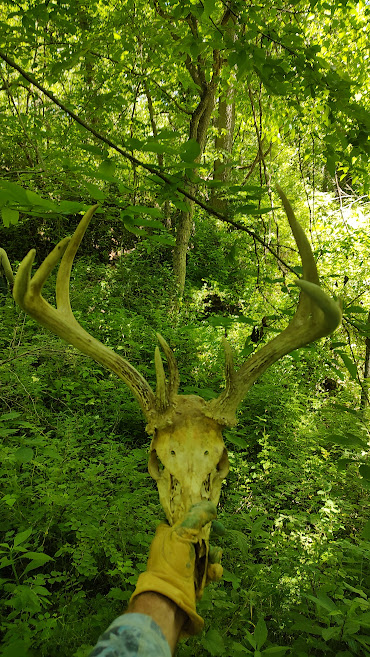
Recently while implementing some timber stand improvement by way of hack and squirt for a customer, I stumbled upon one of a deer hunter’s least favorite things: A dead head. A nice one at that. A solid main frame eight pointer that was just starting a G4 tine on the left side and sporting an extra brow tine on the right. Seeing as many of our customers like to collect and keep sheds, I texted my boss and asked where I should put it. “On top of the car, next to the other one” was his response, in reference to the nice eight point dead head somebody had placed on top of an old car, one of several old dilapidated vehicles discarded and forgotten in the woods in which we had been working. We had seen it there a couple days earlier, and being deer hunters ourselves marveled at it as we drove by. What we didn’t pay much attention to at the time was the car upon which it sat. It was only when I went to place my find next to the other that I got a close enough look at the car itself, and I was surprised to discover that it was some kind of classic muscle car. Although I am not a “car guy” per se, I can still appreciate a good old American hot rod. I placed the skull I found next to the one already there, stepped back and snapped a quick picture, thinking it would make for a cool shot. Of course, I still think it made for a cool shot, but I spent the rest of the day thinking about that image and the similarities between how deer hunters and land managers feel about finding a dead head and how car enthusiasts feel about seeing a car like that junked out and left to rot. I put on a podcast to listen to while I worked, Steven Rinella’s recent Meat Eater Podcast in which they discussed the life and works of Aldo Leopold and his many contributions to wildlife conservation. From their discussion I drew a third parallel as it relates to land management when Steve recited a quote from fellow podcast participant Doug Duren:
“I see what the farmer gets out of it, I see what the hunter gets out of it, but what does the land get out of it?”
As any deer hunter knows, finding sheds in the spring can be exciting. Many of our customers, much like many deer hunters, like to keep and collect any sheds found on their property. It is not uncommon for us to leave sheds somewhere for the land owner to retrieve later. Finding sheds from the same deer year over year can prove to be a fun way to track the growth and progression of bucks as they get older, and can serve as an estimator for what a buck’s potential peak may be. Finding those sheds still attached to the skull of a buck that didn’t make it to the next year can be absolutely disheartening, and it can present a lot of questions about what might’ve happened and what might’ve been. Was it predation? Disease? Wounded by another hunter and never recovered? How big would he have gotten? These questions can eat at a hunter who knows they may have missed out on an opportunity to harvest a good buck. One of the risks a lot of hunters take is passing on what they estimate to be a young deer, choosing to let him walk instead in hopes that he’ll put on more mass next year with no guarantee that he’ll make it to next year. The best we can hope for is that he at least had the opportunity to breed and pass on those genetics for another generation.
Upon further evaluation, along with side-by-side comparisons to pictures on the internet, I determined that the car the dead heads now reside on top of is either a 1966 or 1967 Pontiac GTO. It’s tough to tell exactly what year, considering the doors are sticking out of the trunk, the hood is upside down on the roof, the front bumper, grill, and quarter panels are stuffed inside the cab, and by the looks of the brush growing up around it the car has been there for a number of years. What makes this car particularly interesting to me (and equally disappointing) is that my dad had a 1967 GTO when he was younger. I’ve heard countless stories about what a fast, mean hot rod it was. Sometimes he wishes he hadn’t gotten rid of it, and I couldn’t help but wonder what kind of life this car might have lived, and what it would look like today if it had been properly cared for and not discarded in a forest on our customer’s property. A car like that, in my opinion, belongs on the road. If nothing else it should live a life of luxury circuiting around local car shows for fellow enthusiasts to admire and enjoy or serving as a head turner in a homecoming parade. I pondered what it might take to restore it to its former glory, but unfortunately I think she’s too far gone at this point to even think about saving.

As I hacked my way through the timber, machete in one hand and spray bottle full of chemical in the other, I chewed on that question; “what does the land get out of it?” Land can be an extremely valuable resource whether it’s used for agriculture or recreation or even simply as an investment. But what is that land really worth if it doesn’t also benefit from our having it? Furthermore, how can we expect to reap the benefits of our land’s potential if we aren’t putting anything back into it? Keeping with the Aldo Leopold theme from the podcast, Leopold opines in A Sand County Almanac about the minimal input that landowners and farmers have on their land, confining themselves to doing just enough to remain profitable without having to sacrifice too much money, time, or resources. While much headway has been made over the years in the promotion of conservation practices like cover crops and efforts to minimize soil degradation and runoff, many of these practices still generally stop short of doing anything that isn’t ultimately profitable, at least not until its already too late. State and federal cost-share programs like those found in the Farm Bill help alleviate some of that profit loss, but it can still be hard to sell a farmer on taking good viable land out of row crop production in exchange for wildlife habitat if there is no foreseeable financial reward beyond simply offsetting the cost of taking said land out of production. Likewise many owners of recreational hunting land are easily misguided into focusing on producing trophy game rather than on sustaining a healthy ecological community in which all parts can become beneficial to one another.
I thought about the very woods we were working in, its purpose and use being almost exclusively recreational in the form of hunting. As evidenced by the junked out old cars strewn about the hilltop, it is fair to say this piece of property has long-suffered from years of neglect in terms of conservation input. At the end of the day I was able to revel in the fact that at least the work we were doing by thinning the stand of undesirable and/or invasive species might be able to breathe new life into the forest. This could in turn promote and sustain a healthy wildlife population which the landowner can reap the benefits of for many years to come. So while the dead heads can’t be brought back to life and restoring the cars would be an exercise in futility, there’s still something for the land itself to get out of the work that has been put in. I consider this to be the ample reward that we so often receive from the hours and sweat we pour into the properties that we work on, and it serves as reinforcement for the career path in conservation that I have chosen. It also serves as a challenge to any and all landowners, whether agricultural or recreational; what is the land getting out of your using it?
 The Hunting Lodge