I have hunted for many years, pursued many different types of game, used countless hunting methods, and tried many new things in the process. As such I have been subject to more than my fair share of failures that have left me headed home empty-handed, with only my unfilled tags to eat. On the subject of failure there is an endless supply of witticisms and clichés that we can turn to for inspiration and encouragement. “Don’t let the fear of striking out keep you from playing the game,” “If at first you don’t succeed, try, try again,” and “every time you get knocked down, get back up again” are a few that come to mind right off the top of my head. Each one of these statements holds its own respective intrinsic value, and can be utilized as proper motivation when applied to various scenarios and situations.
Failure is often referred to as the “hardest lesson learned” because it can teach you what you’re doing wrong. Failure is where you realize what went wrong, how it all came apart, and if you approach it with the right attitude, what you need to do next time in order to have success. I’ve certainly taken some hard lessons in my time (such as falling asleep in the deer woods only to wake up to 5 does within 20 yards, all staring at me). I have easily been dissuaded from pursuing things not only in hunting but in the rest of my life as well, overwhelmed by the certainty of my eventual failure. Through hunting, I have worked to surmount failure and learn those bitter moments in pursuit of the sweet nectar of success.

Recently I have been plagued by a couple of hunting failures that have been an absolutely phenomenal experience thus far. Most notably has been the use of a trail camera, which I had never done before prior to last year. Eager to get it up at the property to see what kind of activity I could find, I set it up in the patch of timber that my friends and I have been hunting the last several years. Its area where we have all killed deer, and I just wanted to know what else was moving through the area. I only let it set a couple of weeks before I was back swapping out SD cards, and I was thrilled to find the camera had captured about 90 photos in that relatively short time span. Imagine my surprise and utter disappointment when I popped that card in my computer and found that the photogenic critters I had on film were almost exclusively, save for a couple of me setting the camera up, the farmer’s herd of cows, and that for some strange reason on one particular morning said farmer had the bright idea to run those cows down through the woods right across in front of my camera. Talk about taking the wind out of your sails!
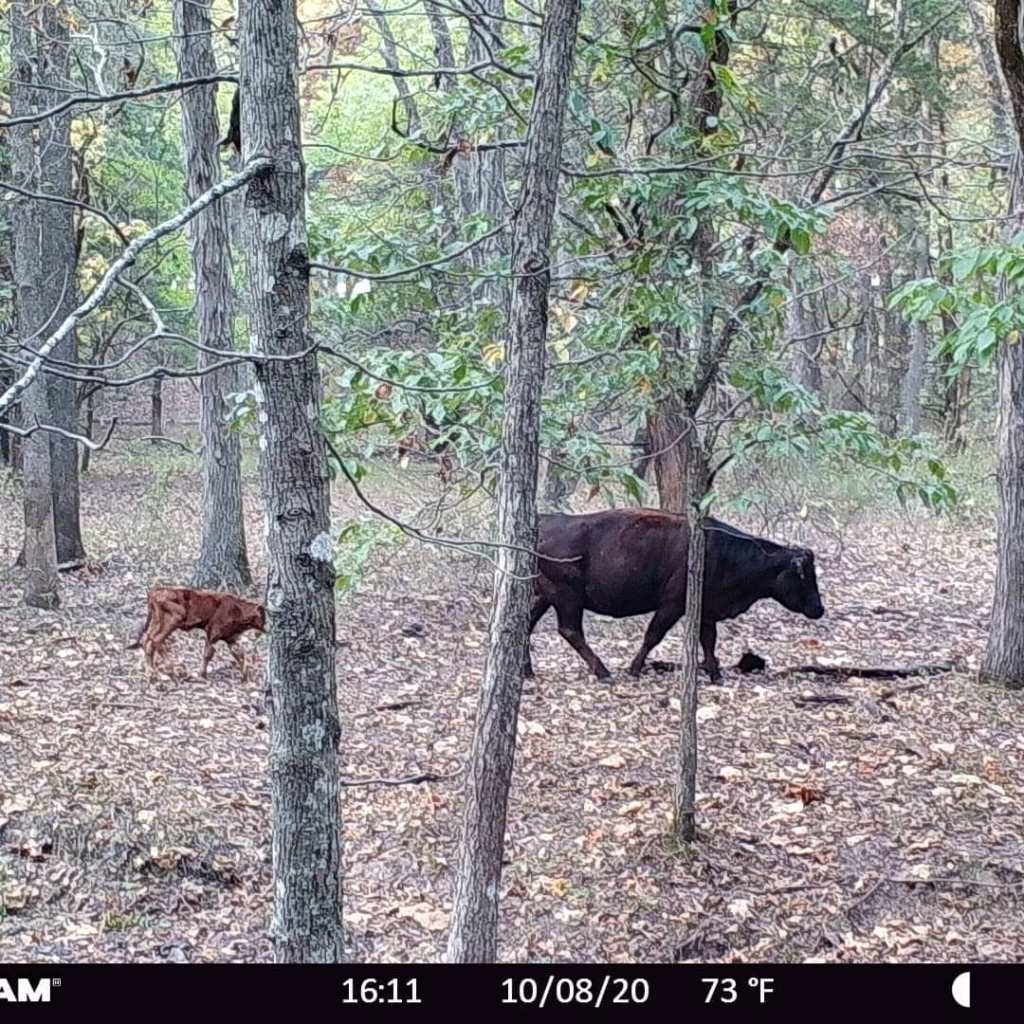
The first lesson I learned was that it is NOT a good idea to set a camera up in area that the cows not only have access to, but actually frequent and spend considerable time in. I realized that usually right before deer season, the farmer moves his herd into the lots up by the barns every year, so they don’t disturb our hunting. This is why I rarely see cows out there when I’m hunting, and I suppose I just didn’t realize how popular an area my hunting grounds were for them. With this noted, I promptly moved the camera over by my dad’s deer stand further south in an area not so heavily traversed by the aforementioned bovines. The second lesson I incorporated was leaving the camera sit for a longer period of time, to allow more opportunities for use. Since it was getting close to deer season, I went the extra step by throwing out some doe estrus in front of the camera with hopes of attracting some bucks to the area.
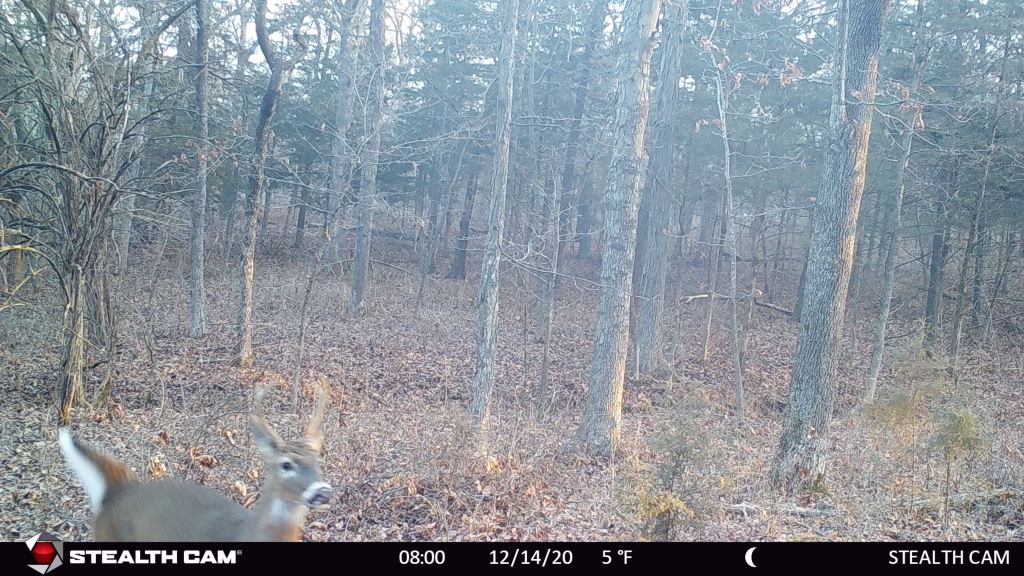
I left the camera all through deer season, occasionally replenishing the estrus urine supply to (hopefully) keep them coming to it, and then let it sit all the way into the new year. I was again shocked by what I found on the camera, but this time for completely different reasons, and not good ones either. Aside from one pesky squirrel and the occasional blur of what I can only assume was bird darting by, in all those months I only managed to capture one deer on the camera. On a particularly cold morning in December my camera was visited by a little fork horn, and that was it. I found this extremely troubling considering I actually shot a button buck out of that stand on the third day of season, but alas the camera was facing a different direction than the one from whence he came. I know there are deer out there, our club manages to kill several every year which usually includes a nice shooter buck or two. For me to have that camera up for almost three months and only photograph one little fork horn was incredibly disheartening. This probably explains why hunting from that stand can sometimes be a slow grind, and why I see very little action that is a far cry from consistent. Once more it was time to regroup and retool, because I paid good money for a camera and I was dead set on getting some quality deer pictures out of it before I threw in the towel.
During the antlerless portion of the Fall Firearms season my buddy discovered a spot on the other side of the property rife with fresh rubs not far from where he stumbled onto some deer scat that was so fresh it was still steaming when he found it. On a line that stretched from one patch of timber, across a small meadow, and up the hill on the other side we counted approximately 25-30 small trees that had been absolutely tore up along the bottom two to three feet of the trunk. This was undoubtedly the handiwork of an aggressive and extremely territorial buck asserting his dominance over these woods. I decided that this was going to be the new spot for my camera, although a couple of the other guys in the club had already laid claim to those woods. I just wanted to put a face (and rack) to this alpha energy stud!
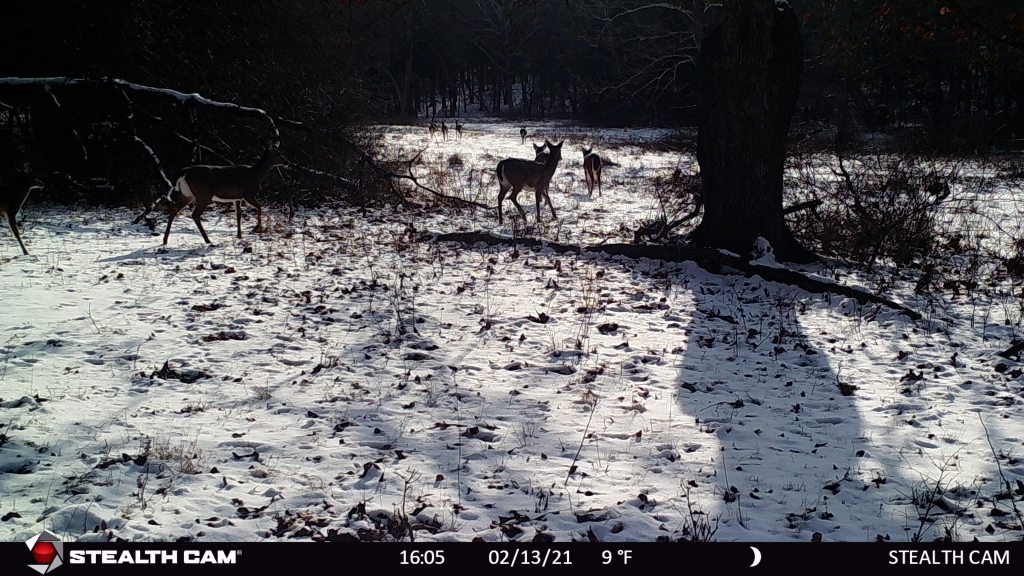
I set the camera up facing the meadow right next to where multiple deer trails converged and ran right out into the field. This time I let it go for about a month undisturbed. This time what I found when I finally checked it was absolutely exhilarating! Through two major snow events and temperatures that ranged from the 50s to as low as -14o I got pictures of the neighbor’s dogs, a few squirrels, and a couple of coyotes. But the real treasure? Deer! Lots and lots of deer! I had finally found a well-travelled path that they were actively using and got some good quality shots. Of course, notably absent from these pictures were antlers. Over 100 pictures, most of them being of deer, not once did I capture a buck on camera. Nonetheless this was an exciting experience as it meant that maybe I’m actually learning something through this trial-and-error process. The only real downside, as I stated before, was that a couple of other guys already had this area locked down for hunting season. I decided I should probably put the camera up somewhere that I want to actually hunt and not encroach on those guys’ spot.
Back to the other side of the property I went with it, settling on a section of timber that rests almost directly in between my first camera location (cows) and my second at dad’s stand (fork horn). We have seen deer come through and from that area, and there was plenty of sign of activity to suggest it had promise. So I found a good spot with a pretty clear view across a small ravine between the two hills and strapped it to the tree. If all went well, I was considering hanging a stand there to try my hand by next season. I had already grown so much in this process since just last summer, and I could only hold myself back for a couple of weeks before my eager anticipation got the best of me and I was right back out there swapping the card. This time I also had an ulterior motive, however. By this point it was early March and I was wanting to know why I wasn’t finding any sheds yet like a lot of my friends were, as I knew they should be dropping by this point.
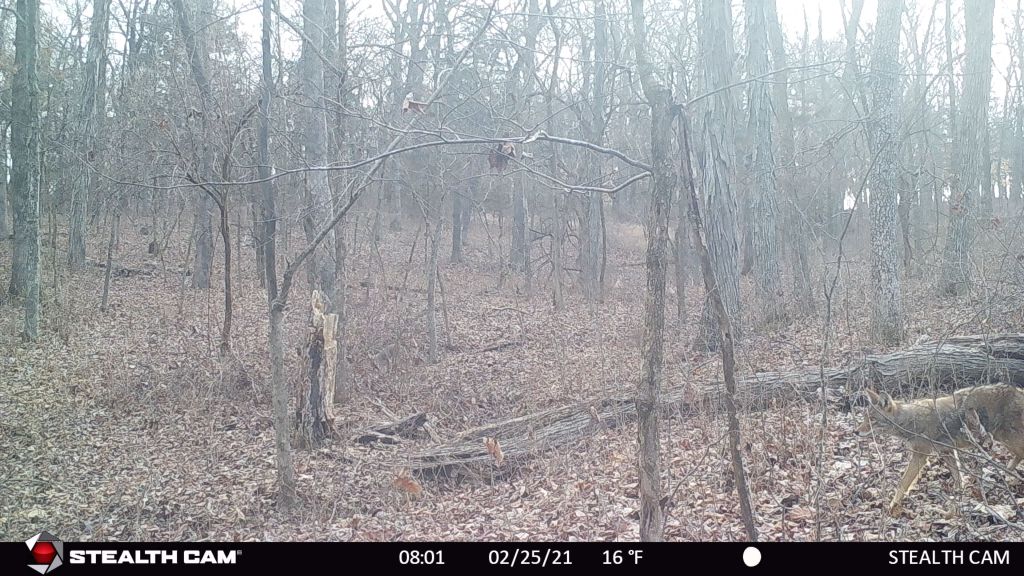
The new camera location came through big time on multiple fronts. The first picture I got was a coyote the first morning after I set the camera up. Seems like it may be high time for some predator control work on the property. After that, though, I got about two dozen shots of deer moving through on a regular basis. So it looks like I’ll probably be putting up a stand over there after all, that’s good news. On the antler shed front, while it was hard to be 100% sure as the deer was mostly concealed behind some trees, it appeared that as late as March 7th, at least one buck in the area was still sporting his bones. So another lesson was learned along the way, which was that I wasn’t finding sheds because, well, they probably hadn’t been shed yet. Some follow up research on the subject rendered more positive news, which was that deer hanging on to their racks later into the winter is generally a sign of good health.
To recap; I started with a camera and a dream of capturing lots of deer movement, wound up with a bunch of pictures of cows, then virtually no sign deer activity where I hunt, found the deer in an area that is essentially inaccessible to me, and finally found an area that I think is going to become my new hunting spot, should the pictures continue to produce. And for kickers, I got a read on predator activity and learned a thing or two about shed hunting. I was driven to do better by my failures rather than to give up, as I could have done just as easily.
Because of this experience I have gained a newfound respect and appreciation for failure by choosing to focus on the positive potential that my particular failure had to offer. In the face of adversity, I learned to be willing to adjust, to try new approaches, and exercise patience and trust in the process. I knew I might strike out at the beginning, and I did. But that didn’t stop me from playing the game. I kept after it, learned some hard lessons, and (fingers crossed) laid the foundation for future success in the deer woods. Because that’s what the ancient art of hunting is really all about!
 The Hunting Lodge